
What home builder marketing actually has to solve
Most marketing advice assumes unlimited supply. A plumber can take one more call; a pest control company can add one more route. A builder cannot. You have a finite number of lots in a fixed location, released on a schedule, and every home you sell removes an option from your own inventory. That single constraint reshapes the strategy.
It produces five problems marketing has to solve, roughly in this order:
- Point demand at the right inventory. A community with two remaining lots does not need more traffic. A spec home standing at day ninety needs a lot of it. Marketing that runs at the brand level cannot make that distinction, which is why budget allocation matters more here than in almost any other local category.
- Compete with portals for your own name. Third-party listing sites frequently outrank builders for their own community names. You either earn that visibility yourself or keep paying to be introduced to buyers who were already looking for you.
- Answer the questions that decide a visit. Price range, availability, square footage, school district, HOA, lot premiums, what is included versus an upgrade, and how long the build takes. A buyer who cannot find these things does not call to ask — they open the next tab.
- Get an appointment, not a form fill. The conversion that predicts a contract is a kept model home appointment. Registrations are a leading indicator at best, and a vanity metric at worst.
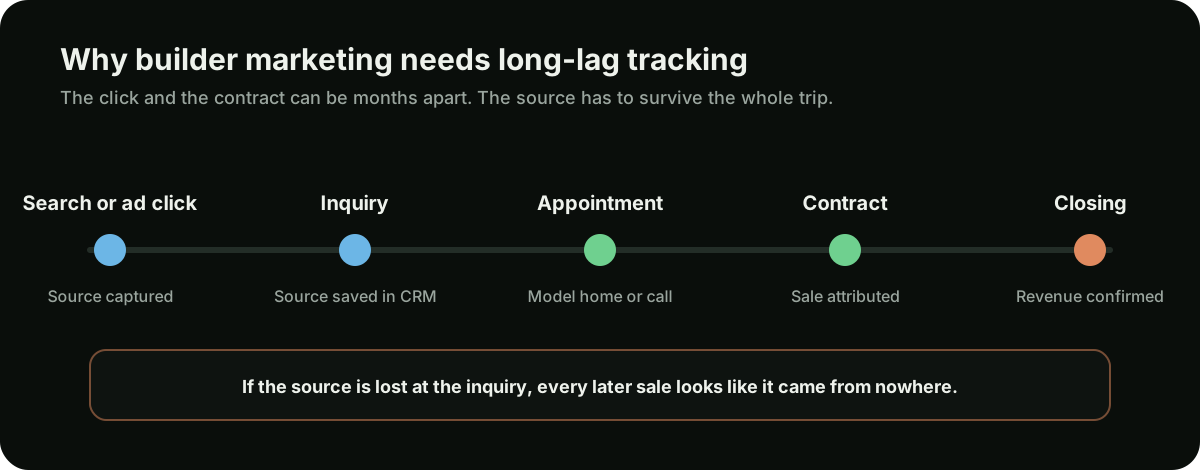
- Survive the sales cycle in your reporting. When the lag between inquiry and contract is months, any channel judged on a thirty-day window looks broken. Attribution has to be built for the real timeline before anyone can make a sound budget decision.
A sixth factor sits underneath all of it: your buyer mix decides what an inquiry is worth. A quick move-in buyer and a to-be-built buyer arrive through different searches, need different information, and close on different timelines. Marketing that treats them as one audience underserves both.
How do new-home buyers actually search?
New-home buyers usually start with an area and a price, not a builder. Early searches look like new homes in [area], new construction homes near me, or new builds under [price], and they are answered largely by listing portals. Buyers reach individual builders later — through a community name, a floor plan name, a drive-by sign, a realtor, or a branded search after seeing an ad. By the time someone searches your company name, they are often close to a visit.
That progression matters because each stage needs different work:
- Area and price discovery. High volume, low intent, portal-dominated. Worth competing for through genuinely useful area and community content, rarely worth heavy paid spend at the broadest level.
- Community and neighborhood searches. A buyer searching a community name has been handed to you by a sign, a portal, a friend, or an ad. This is the most valuable organic search a builder can own, and the one most commonly lost to portals.
- Floor plan and model name searches. Low volume, remarkably high intent. Someone searching a plan name has seen it, is comparing, and wants specifications. Very few builders give these searches a real page.
- Quick move-in and availability searches. Move in ready homes, homes available now, quick move in homes [area]. The shortest path from search to contract in the entire category, and the best fit for paid search.
- Decision and reassurance research. Build timelines, warranty, what is standard, design center process, financing and rate buydowns, buying new versus resale. This content earns trust with buyers who will sign months later.
- Realtor searches. A separate audience with separate queries about commission, co-broke policy, and what is available to show. Covered further down.
- AI assistants. A growing share of buyers ask an assistant to shortlist builders or explain the process. What earns a mention is largely what earns good SEO: clear, specific, consistently stated facts. See below.
Two implications follow. First, your community pages are the most important commercial pages on your site — more important than your homepage — because they are where the highest-intent organic and paid traffic should land. Second, the research-stage content is not a blog obligation; it is how you stay in the consideration set of a buyer whose timeline is nine months long.
The two funnels every builder runs at once
Almost every reporting argument inside a builder's marketing meeting comes from averaging two funnels that behave nothing alike. Separating them makes the numbers legible.
| Quick move-in / spec | To-be-built / presale | |
|---|---|---|
| Buyer situation | Needs a home soon — relocation, lease ending, home already sold | Planning ahead, wants choice of lot, plan, and finishes |
| Typical cycle | Weeks to a couple of months | Several months to a year or more |
| What they search | Availability, move-in dates, price, address | Communities, floor plans, school districts, build process |
| Best-fit channel | Paid search and inventory listings | Organic search, paid social, email nurture |
| What converts | A specific home with a price, photos, and an available date | A community that feels right, then a conversation |
| Reportable inside a quarter | Usually yes | Usually no — report appointments, not contracts |
The practical consequence is that these two funnels should not share a campaign, a landing page, or a cost-per-lead target. A quick move-in campaign can be judged in weeks and scaled or paused accordingly. A to-be-built campaign judged on the same window will be cut before it has had the chance to produce anything, which is the single most common way builders destroy a channel that was working.
It also changes what you ask for on a form. For a quick move-in buyer, timeline is the qualifying question. For a to-be-built buyer, it is lot and plan preference — asking someone eleven months out to commit to a move-in date creates friction with no diagnostic value.
The numbers to know before you spend anything
Four figures make almost every builder marketing decision straightforward, and you can calculate all four from data you already have in your CRM.
Cost per qualified inquiry
Channel spend divided by inquiries that matched your price band, area, and timeline — not raw registrations. Track it per community, because a premium community and an entry-level one will never share a number.
Inquiry-to-appointment rate
Kept model home appointments divided by qualified inquiries, split by source. This is the fastest honest read on lead quality, and it is available weeks before any contract data.
Appointment-to-contract rate
Contracts divided by kept appointments. Largely a sales and product number rather than a marketing one, which is exactly why it should be measured separately.
Marketing cost per home sold
Total marketing spend attributable to a community divided by homes sold in it. The number that tells you whether the whole programme is viable, and the one to compare against your per-home margin.
Two more figures matter specifically to builders. Days on market for standing inventory decides urgency — a spec home carrying interest at day 120 justifies spend that would be irrational at day 20. And absorption rate, the homes you sell per month in a community, tells you whether marketing needs to accelerate demand or whether the constraint is release schedule and you would be buying inquiries you cannot serve.
Worked example, using round illustrative numbers rather than industry data: if a paid search campaign produces qualified inquiries at $250, and 30% of those become kept appointments, your cost per appointment is roughly $833. If one in five kept appointments produces a contract, your marketing cost per home sold from that channel is about $4,165. Whether that is excellent or unacceptable depends entirely on your gross margin per home — which is why the arithmetic has to come before the channel argument. The same math, run on a $180,000 entry-level home and a $900,000 move-up home, produces completely different answers about what you can afford to bid. You can run these numbers for your own communities in the cost per lead calculator, and our guide on how to set a home builder marketing budget walks through turning them into a spend plan.
How should builders market individual communities?
Treat each community as its own small business with its own page, its own campaigns, its own budget, and its own inventory position. Then allocate spend by what each community actually needs: heavy support during a release and when inventory is standing, light or paused when it is nearly sold out. Marketing at the brand level only is the most expensive habit in builder marketing, because it spends the same money on a community with two lots left as on one with forty.
A workable allocation framework, in three buckets:
- Brand and area presence (a steady baseline). Your company name, your reputation, your area-level content, your realtor relationships. This is what makes every community campaign cheaper, and it should not be switched off between releases.
- Community campaigns (the largest variable share). One campaign per selling community, budgeted against remaining inventory and absorption rate. New releases and slow communities get more; nearly sold-out communities get enough to finish and no more.
- Inventory pressure (tactical and short-lived). Standing spec homes and quick move-ins past your target days-on-market. Highest-intent keywords, a landing page for the specific address, and a hard stop when it sells.
Two disciplines make this work. The first is a sellout protocol: when a community closes out, campaigns pause, but the page does not disappear. It keeps its URL, states its status honestly, and points buyers to comparable open communities — which preserves the search visibility that community name earned. The mechanics of this, including when a redirect is genuinely the right call, are in our guide to local SEO for home builders.
The second is a release calendar that marketing sees early. Paid campaigns can be live the day lots release; organic visibility for a community name takes weeks to months. A builder who tells marketing about a release the week it opens has already given away the cheapest inquiries that community will ever produce.
Where the communities are matters too. Competition, portal presence, and inquiry costs differ a lot from one metro to the next. We concentrate on Raleigh, Charlotte, Austin, Dallas, and Fort Worth, among others; see the markets we focus on.
Does SEO work for home builders?
Yes, and for a specific reason: builders have genuinely unique content to publish. Communities, floor plans, and available homes are real entities with real specifications, which means a builder can build a substantive site without resorting to the thin location pages that sink most local SEO efforts. The realistic goal is not to outrank the national portals for new homes in [city]. It is to own every search attached to your own communities, plans, and brand, and to rank for the area and decision-stage searches portals cover poorly.
The structure that works is built from four page types:
- Community pages. The commercial core of a builder site. One page per selling community, with price range, available plans, lot status, amenities, school district, HOA details, location, and a clear next step.
- Floor plan pages. One per plan, with square footage, bed and bath counts, garage, options, elevations, and the communities the plan is available in. Low search volume, high intent, and almost always underbuilt.
- Inventory pages. One per available home, with address, status, price, completion date, and photos. These are the pages quick move-in buyers are actually looking for.
- Area and decision content. Honest pages about the areas you build in and the questions buyers research — build timelines, what is standard, new versus resale, the design center process, warranty.
Two mistakes are worth naming here. The first is generating a page for every city and suburb within an hour's drive; it is the same doorway-page pattern that fails everywhere else, and builders have no need for it when communities provide legitimate geographic content. The second is building the community finder as a JavaScript map with no crawlable links behind it, which hides your best pages from search entirely. Both are covered in detail in our guide to local SEO for home builders, and the underlying approach is on our local SEO service page.
Should home builders use Google Ads?
For most builders with active inventory, yes — but not as a general traffic source. Google Ads earns its place because it is the only channel that lets you move demand to a specific community or a specific standing home within hours. That control is worth more to a builder than incremental volume. It is a poor fit if you have nothing to sell for two months, or if you cannot yet get inquiries answered quickly, in which case the spend subsidises your competitors' follow-up.
Where paid search reliably pays for itself:
- Quick move-in and availability searches. Short cycle, clear intent, measurable inside a quarter. The best possible starting point.
- Your own brand and community names. Inexpensive, high-converting, and the practical defence against portals and competitors bidding on the demand your signage and referrals created.
- Individual standing homes. A tight campaign pointed at one address, running only while it is unsold.
- New community releases. Immediate visibility for a community name that organic search will take months to earn.
Two structural points matter more for builders than for most advertisers. Negative keywords do unusually heavy lifting, because homes, builder, and construction attract rentals, job seekers, manufactured and modular housing, apartment hunters, and free house-plan downloads. And because contracts arrive months after the click, conversion data has to include appointments set — and ideally contracts imported back from your CRM — or the platform will optimise toward whatever cheap registration it can find. Both are covered in Google Ads for home builders, alongside our general Google Ads management approach.
Meta Ads: creating demand instead of waiting for it
Paid search captures buyers who are already looking. Meta reaches the much larger group who would move if the right thing appeared in front of them — and new homes are a genuinely visual product, which suits the platform.
The cases where Meta Ads work best for builders:
- Community releases and grand openings. A dated event with a location is one of the few offers social advertising handles better than search.
- Incentives and rate programmes. Rate buydowns, closing cost contributions, and design credits are time-bound offers nobody is searching for by name.
- Standing inventory. Photos of a finished home with a price and an available date, targeted to the areas your buyers move from.
- Re-engaging your database. Past inquiries who were not ready, matched as an audience. Usually the cheapest source of appointments a builder has.
Two cautions. Expect a lower inquiry quality rate than search, and judge the channel on appointments rather than registration volume — social leads arrive earlier in the decision and need more qualification. And keep housing advertising compliance front of mind: ads promoting the sale of housing sit under Meta's special ad category rules, which restrict audience targeting by age, gender, and geography in ways that will break a campaign built on ordinary targeting assumptions.
What should a home builder website contain?
At minimum: a crawlable community finder, a page for every selling community, a page for every floor plan, a page for every available home with its status and price, real photography of finished homes rather than renderings alone, the information buyers need to self-qualify — price range, square footage, school district, HOA, what is included — and one obvious next step on every page. Most builder sites have the first three and lose buyers on the rest.
The recurring conversion problems on builder sites are consistent enough to list:
- Prices hidden behind a form. Withholding a price range does not create urgency; it sends buyers to a portal that will publish an estimate you did not approve. Publishing a range qualifies buyers before they occupy your sales team's day.
- Status that is not stated. “Coming soon”, “now selling”, “final opportunities”, and “sold out” are the labels buyers scan for. Ambiguity reads as unavailable.
- Renderings where photographs belong. Renderings are necessary before a model exists and a liability once one does. Buyers know the difference and trust the photograph.
- One generic contact form for everything. The inquiry should carry the community and plan the buyer was looking at. Without that, routing and reporting both degrade immediately.
- Galleries that make the page slow. Builder sites are image-heavy by nature, which makes image discipline — modern formats, correct dimensions, lazy loading below the fold — a conversion issue rather than a technical nicety.
- No mobile priority. A meaningful share of visits happen from a phone in the car outside the community. Address, directions, hours, and a tap-to-call number should be immediate.
Full detail on page anatomy and lead capture is in our guide to websites for home builders; how we build and instrument them is on the websites and landing pages service page.
Driving model home traffic
The model home is a builder's highest-converting asset and the one most often marketed as an afterthought. Two things reliably increase traffic to it.
The first is treating the sales center as a real location. A staffed model home with published hours qualifies as a physical location, which means it can have a Google Business Profile with accurate hours, photographs, and directions. Buyers searching on a phone nearby are then given a map pin and a call button rather than a homepage.
The second is asking for the appointment instead of the inquiry. “Request information” produces a registration that someone has to chase. “Schedule a tour” with visible availability produces a calendar entry, which converts far better because the buyer has already made a plan. Keep a lower-commitment option for people who are not ready, but make the appointment the primary action.
Practical details that decide whether a visit happens: directions that work from the highway rather than a pin in an unfinished subdivision, hours that are accurate on holidays and during model relocations, a phone number someone answers on a Saturday, and a confirmation with a reminder before the appointment. Appointment no-shows are usually a reminder problem, not an interest problem.
Marketing to realtors and co-broke agents
Depending on your market and price point, agents can account for a substantial share of a builder's contracts. They are a separate audience with separate questions, and most builder websites answer none of them.
What an agent needs, and rarely finds:
- A stated co-broke policy. Commission structure, registration requirements, and when a client must be registered. Vagueness here costs you showings.
- Current availability in a usable form. Inventory with status, price, and completion dates that an agent can send to a client without editing.
- A named contact. Who to call about a client, not a general form.
- Plan documents and specifications. Floor plans, included features, and lot maps an agent can share.
An agent-facing page is worth building for its own sake, and it also earns organic visibility for a small but valuable set of searches from agents looking for new construction options in your area. Note that agent inquiries should be tracked as their own source — they behave nothing like consumer registrations, and blending them distorts every conversion rate you report.
Lead response and the online sales counselor
Response speed is the most controllable conversion lever a builder has. A new-home inquiry is usually sent to several builders in one sitting, so the first substantive reply sets the frame for the comparison. The realistic standard is minutes during business hours and an immediate acknowledgement outside them — and the goal of the first contact is one thing only: an appointment on the calendar.
What makes this work in practice:
- A dedicated online sales role. Inquiries handled between site visits by a community sales manager will be handled late. The builders who convert web inquiries well have someone whose whole job is the first response and the appointment.
- Immediate acknowledgement with substance. An automated reply that names the community, confirms the price range, and offers two appointment times is useful. A generic “we received your message” is not.
- Structured, persistent follow-up. Long cycles mean a single unanswered call is not a dead lead. A defined cadence across email, text, and phone — with the buyer's timeline setting the interval — recovers a meaningful share.
- Nurture for the eleven-month buyer. Release announcements, new plans, incentives, and construction progress keep you present until the timeline arrives. This is where most builder databases are wasted.
- Missed-call recovery. A phone call from a buyer sitting outside a community is the most valuable inbound you get. An unanswered one should trigger an immediate text.
Most of this can be automated without becoming impersonal, which is what our AI automation work covers: instant response, appointment scheduling, reminder sequences, and long-horizon nurture that keeps a human in the loop for anything that matters.
How can builders show up in Google and AI-generated answers?
By publishing specific, factual, consistently stated information that an answer engine can quote. Buyers increasingly ask assistants things like which builders work in an area, what a build takes, or what is included at a price point. The pages that get cited are the ones that answer a question directly, in plain language, with facts that match everywhere else the business appears — not the ones stuffed with adjectives.
What this looks like for a builder:
- State facts plainly and keep them current. Communities, price ranges, areas served, plan specifications, build timelines. Contradictions between your site, your listings, and your profiles make you a risky thing to cite.
- Answer real questions with real answers. A heading that asks a question followed immediately by a direct two-sentence answer is both better for a skimming buyer and easier for a model to extract.
- Use structured data that matches what is visible. Organization, breadcrumbs, and service markup that describes the page's actual content. Never markup describing homes, reviews, or availability that a visitor cannot see.
- Be consistent off-site. Portals, directories, and profiles are part of how an assistant corroborates a fact. Conflicting addresses and price ranges undermine the site you cleaned up.
None of this is a separate discipline bolted onto SEO — it is the same content quality and entity clarity, applied with extraction in mind. Our approach is on the AI search visibility page.
How should builders track leads and consultations?
Track the whole funnel from search to contract, and accept that the useful signal arrives in stages. Registrations tell you a channel is producing volume. Qualified inquiries tell you whether the volume is relevant. Kept appointments tell you whether it is real. Contracts confirm it months later. A builder measuring only the first or only the last is either flying blind or flying late.
The four implementation details that decide whether builder reporting is trustworthy:
- Every inquiry carries its community and plan. Capture them in hidden fields on the form. Without this, you cannot allocate budget by community, which is the whole game.
- Attribution windows matched to the sales cycle. Default lookback windows are far shorter than a builder's cycle. Extend them, and expect first-touch and last-touch to tell genuinely different stories — the discovery channel and the closing channel are rarely the same one.
- Offline conversions imported from the CRM. Appointments set and contracts signed pushed back into the ad platforms is what allows bidding to optimise toward buyers rather than toward cheap form fills. This is the single highest-value technical project in builder marketing and the most commonly skipped.
- Call tracking, separated by community. A large share of builder inquiries are phone calls, often from a car. Untracked calls will make your best channel look like your worst.
One honest caveat: with small monthly contract counts, statistical confidence is genuinely limited. A community selling four homes a month cannot A/B test its way to certainty. The correct response is to manage by reviewing lead quality qualitatively — reading the inquiries, listening to the calls — alongside the aggregate numbers, rather than pretending a sample of four is a trend.
What marketing channels work together best?
Channels do not compete for the same job. A workable default sequence, assuming a builder with active inventory and a functioning website:
| Stage | What you do | Why it comes here |
|---|---|---|
| 1. Measurement | Call tracking, form tracking with community fields, CRM stages, offline conversion import | Everything after this is unreadable without it |
| 2. Response | Online sales coverage, instant acknowledgement, appointment-first CTAs, missed-call recovery | Fixing follow-up raises the return on every channel at once |
| 3. Website conversion | Community, floor plan, and inventory pages that let buyers self-qualify | Cheaper than buying more traffic for a page that cannot convert it |
| 4. Brand and community search | Defend your own names in paid and earn them organically | The least expensive inquiries you will ever buy |
| 5. Quick move-in paid search | High-intent campaigns on availability terms, per community | Fastest measurable return, funds the rest of the programme |
| 6. Organic depth | Area content, decision-stage content, floor plan pages, technical foundations | Compounds; reduces portal dependence over quarters |
| 7. Paid social and nurture | Releases, incentives, standing inventory, database re-engagement | Creates demand and recovers the long-timeline buyers already in your database |
Stages one and two come first because they are multipliers, not channels. A builder who doubles ad spend before fixing response time has bought more inquiries for the same follow-up process to lose. The ordering is also what we look at first in an audit — it is usually clear within an hour which stage is the constraint.
Common home builder marketing mistakes
- Spreading budget evenly across communities. Inventory position, not fairness, should decide allocation.
- Judging the to-be-built funnel on a monthly report. The channel gets cut months before its contracts would have landed.
- Letting portals own your community names. Paying for introductions to buyers who were searching for you specifically.
- Hiding price ranges. Creates unqualified inquiries, wastes sales time, and hands the estimate to someone else.
- Deleting sold-out community pages. Throws away earned visibility and breaks every link that pointed at it.
- Building the community finder in JavaScript with no crawlable links. Hides your most valuable pages from search.
- Generating a page for every nearby town. The doorway-page pattern, with no upside for a builder who has real communities to write about.
- Optimising ads to form fills. Without appointment and contract data fed back, the platform finds the cheapest registrations, not buyers.
- One generic inquiry form. Destroys routing and makes per-community reporting impossible.
- Ignoring the database. The long-timeline buyer who inquired last spring is cheaper to convert than anyone you can buy today.