
How Google Ads actually works for an HVAC company
HVAC Google Ads work on an auction: you choose the searches you want to appear for (such as ac repair near me or furnace replacement [town]), the areas you serve, and what you are willing to pay, and Google shows your ad when a homeowner in that area searches. You pay when someone clicks or calls from the ad. The accounts that work are split by job type, block irrelevant searches, send clicks to a matching landing page, and measure booked jobs rather than clicks.
The mechanics matter because they explain where money goes. When a homeowner searches, Google runs an auction among advertisers whose keywords match. Position and cost are not decided by bid alone — ad relevance, expected click-through, and landing page experience all feed into it. Two contractors bidding the same amount can pay very different prices for the same click.
For HVAC that produces a specific set of levers:
- You choose the searches. Which job types you bid on decides what kind of work arrives, and it is the most consequential decision in the account.
- You choose the geography. Down to city, ZIP code, or radius — which should follow drive time, not a circle on a map.
- You choose the message and destination. Ad copy and landing page influence both cost per click and conversion rate, which is why relevance is cheaper than volume.
- You choose what counts as success. This is where most accounts go wrong. If a click counts as success, you will buy clicks. If a booked call counts, bidding starts chasing booked calls.
One structural feature of HVAC deserves emphasis: most conversions are phone calls, not form fills. Someone with no heat is dialling, not typing. That makes call assets, call tracking, and answered-call rate the centre of a paid search programme rather than an afterthought.
Is Google Ads worth it for HVAC companies?
It is worth it when three conditions hold: you have capacity you want filled, your average ticket can support a paid acquisition cost, and someone answers the phone reliably. Google Ads is the only HVAC channel that can be turned up during a heat wave and down in a quiet month, and it produces calls within days rather than months.
It is not worth it if calls go to voicemail during peak hours, if there is no tracking to tell you which spend produced work, or if the budget is too small to gather enough data to optimise on. In those cases the fixes come first, then the ads.
The comparison worth making is not "ads versus SEO" but "ads versus the alternative use of that money". If a technician is idle two days a week, the cost of that idleness usually exceeds the cost of the campaign that would fill it. If you are already turning work away in August, the same budget is better spent on shoulder-season demand and maintenance agreements.
Campaign structure by job type
The single biggest structural error in HVAC accounts is one campaign containing every service. Emergency repair, planned replacement, maintenance, and commercial work have different urgency, different job values, and different acceptable cost per lead. Combined, they average into a number that tells you nothing and a bidding strategy that serves none of them.
| Campaign | Typical intent | Why it needs its own campaign |
|---|---|---|
| Emergency / no-cool / no-heat | Immediate, decided in minutes | Highest urgency and often the highest click cost. Needs its own budget priority, its own hours, and messaging built entirely around availability |
| AC repair and service | Same-day or next-day | Seasonal budget swings, and separate from replacement so repair cost per lead is visible on its own |
| Heating repair and service | Same-day, often after hours | Runs on the opposite seasonal curve to cooling, so it needs independent budget control |
| System replacement / installation | Considered purchase over days or weeks | Much higher job value justifies a higher cost per lead, and the landing page has a different job to do |
| Maintenance agreements | Low volume, low urgency | Small budget, shoulder-season emphasis, measured on agreements sold rather than calls |
| Commercial HVAC | Facilities and property managers | Different keywords, longer sales cycle, different landing page, and cost per lead that would look alarming next to residential |
| Brand | People searching for you by name | Cheap, defensive, and should never be blended into performance reporting for the other campaigns |
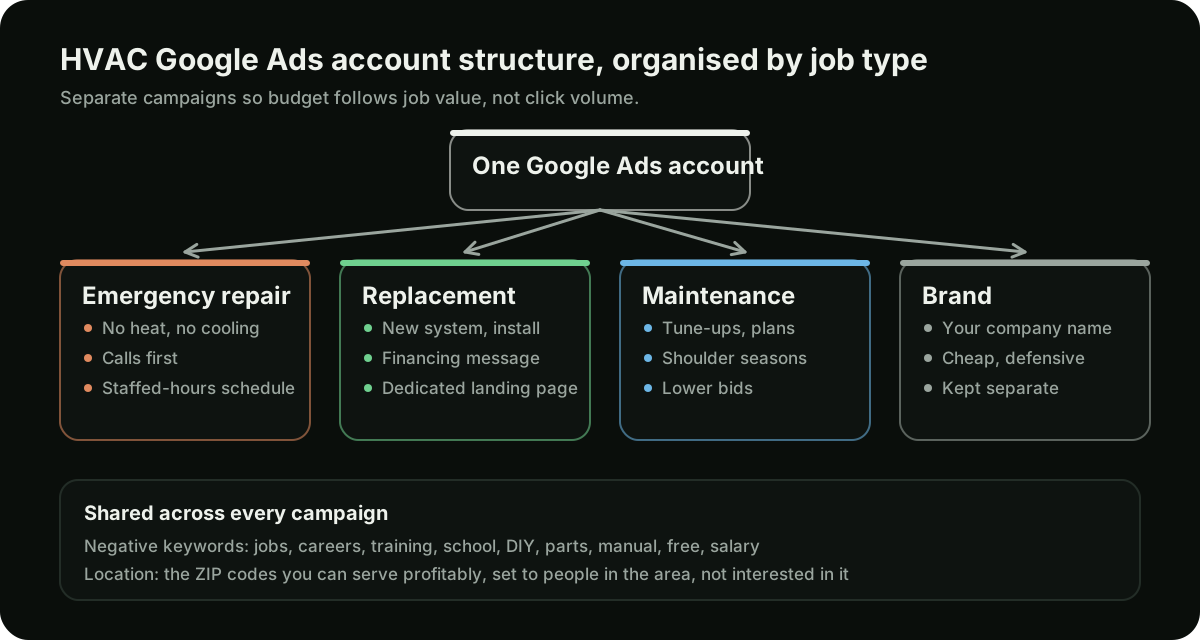
Inside each campaign, keep ad groups tight enough that the ad can genuinely match the search. An ad group covering "ac repair" and "furnace repair" cannot write a headline relevant to both. This is not pedantry — relevance directly reduces what you pay per click.
Where budget is limited, start narrow. Two well-built campaigns on your highest-value work beat seven thin ones spread across everything you do.
Keyword intent tiers
Not every HVAC search is worth buying. Sorting keywords by what the searcher is actually about to do prevents the most expensive mistakes.
| Tier | Examples | How to treat it |
|---|---|---|
| Emergency intent | emergency ac repair, no heat repair now, 24 hour hvac | Bid most aggressively here if you can genuinely respond. Highest booking rate of anything in the account |
| Service intent | ac repair near me, furnace repair [town], hvac technician | Core volume. Exact and phrase match, tight ad groups, dedicated landing pages |
| Replacement intent | ac replacement cost, new furnace installation, hvac system replacement | Higher job value supports a higher cost per lead. Expect longer decision windows and plan follow-up accordingly |
| Comparison intent | best hvac company [town], hvac contractors near me reviews | Worth bidding on where your review profile stands up to the comparison you have just invited |
| Research intent | how long does an ac unit last, what size furnace do i need | Usually a poor fit for search campaigns. Win these organically instead — see the HVAC SEO guide |
| Non-customer intent | hvac parts, hvac training, hvac jobs, diy ac fix | Exclude entirely with negatives. These are not customers and they are happy to spend your budget |
Match types matter more in HVAC than in most trades because the vocabulary overlaps so heavily with parts, training, and DIY content. Broad match on hvac is a reliable way to fund an education for someone else's apprentice.
Negative keywords: the list to build before launch
A negative keyword list is not a maintenance task you get to later. In this trade it is launch-day infrastructure. The categories worth blocking from the start:
- Employment. jobs, hiring, careers, salary, apprentice, technician wanted, resume
- Training and certification. school, course, certification, EPA 608, license, classes, degree
- Parts and equipment shopping. parts, capacitor, compressor for sale, filters, wholesale, supply house, refrigerant price
- DIY. how to, diy, fix myself, youtube, manual, wiring diagram, troubleshoot myself
- Free and cheap. free, cheapest, no cost — qualified with judgement, since "free estimate" may be a term you want
- Competitor and franchise names, unless you have made a deliberate decision to bid on them
- Adjacent trades you do not serve. appliance repair, refrigeration, plumbing, electrician, chimney, if those are outside your scope
- Rentals and portable units, window units, portable ac, if you do not sell or service them
- Out-of-area place names that appear in search terms despite your geographic settings
Then the ongoing discipline: read the search terms report weekly during peak season and fortnightly otherwise, and add negatives every time. This is the highest-return half hour in paid search management, and it is the task most commonly skipped.
Geographic targeting by drive time, not radius
A radius is a circle. Your service area is not. A twenty-mile radius drawn around a shop can cross a river with two bridges, include a metro core you cannot reach inside your promised window, and miss a suburb your crews pass every day.
What to do instead:
- Target by city, town, or ZIP code where the platform allows it, matching your actual coverage.
- Segment by value. Areas where you have route density, strong review presence, or higher-value housing stock deserve higher bids than the fringe of your coverage.
- Set location options to presence, not interest, so you are not paying for someone in another state researching your city.
- Review performance by location monthly. Cost per booked call varies enormously by area, and the differences are usually large enough to act on.
- Exclude areas you cannot serve profitably, even if they generate calls. Declining work you paid to generate is worse than not generating it.
For contractors with multiple locations, run separate campaigns per location rather than one campaign with a combined area. Otherwise budget flows to whichever location happens to be cheaper, which is rarely the one you wanted to grow.
Landing pages that convert paid clicks
Sending emergency traffic to a homepage is the most expensive habit in home service PPC. The homepage has to serve everyone, so it serves nobody with urgency.
What an HVAC landing page needs:
- A headline that matches the search. If the query was emergency AC repair in a named town, that is what the first line should say.
- A tap-to-call number visible without scrolling, repeated as the reader moves down.
- Availability stated plainly. Hours, after-hours coverage, and realistic response expectations.
- A short form for people who will not call: name, phone, address or ZIP, problem. Four fields, not ten.
- Trust signals near the decision. Review count and rating, licence and insurance, years in business, real photographs of your team and trucks.
- Service areas named, so the visitor can confirm you cover them without calling to ask.
- Fast loading on mobile data. Urgent searches happen on phones in uncomfortable houses.
- Pricing logic. What a diagnostic visit involves and how pricing works. Silence on cost sends cautious homeowners back to the results page.
Replacement campaigns need a different page entirely — more explanation, equipment options, financing availability if you offer it, and a path for someone who wants an estimate rather than a technician today.
Call assets and call tracking
Because most HVAC ad conversions are calls, the call infrastructure decides whether the account can be optimised at all.
- Call assets on every ad, so a mobile searcher can dial directly from the result.
- Call-only campaigns are worth testing on emergency intent, where a landing page is friction rather than help.
- Dynamic number insertion on landing pages so calls from paid traffic are attributable and distinct from organic and profile calls.
- Call duration thresholds to define what counts as a conversion. A twelve-second call is a wrong number, not a lead.
- Call recording where permitted, reviewed regularly. Nothing else reveals lead quality, missed opportunities, and how your phone is actually answered.
- Answered-call rate tracked as a marketing metric, because unanswered paid calls are pure loss.
Recording and tracking obligations vary by jurisdiction, so confirm the notice and consent requirements that apply to you before switching recording on. Handled properly, reviewing calls is the single most instructive thing an owner can do with an hour a month.
Missed calls are worth solving with automation rather than willpower — see AI automation for missed-call text back and instant form response.
Conversion tracking that reaches booked jobs
Most HVAC accounts stop at "lead". The account optimises toward cheap leads, and cheap leads are frequently the ones that do not book. Closing that gap is the highest-value technical work in paid search.
The progression to aim for:
- Track the right conversions. Qualified calls over a duration threshold and genuine form submissions. Not page views, not clicks on the number without a connected call.
- Assign different values to different conversion types. A replacement enquiry and a maintenance question should not be worth the same to the bidding system.
- Import booked appointments. When your scheduling or field service software marks an appointment booked, that outcome should flow back into the ad account.
- Import sold jobs and revenue where you can. This is what lets bidding chase profitable work rather than volume, and it is what turns paid search from a lead channel into a revenue channel.
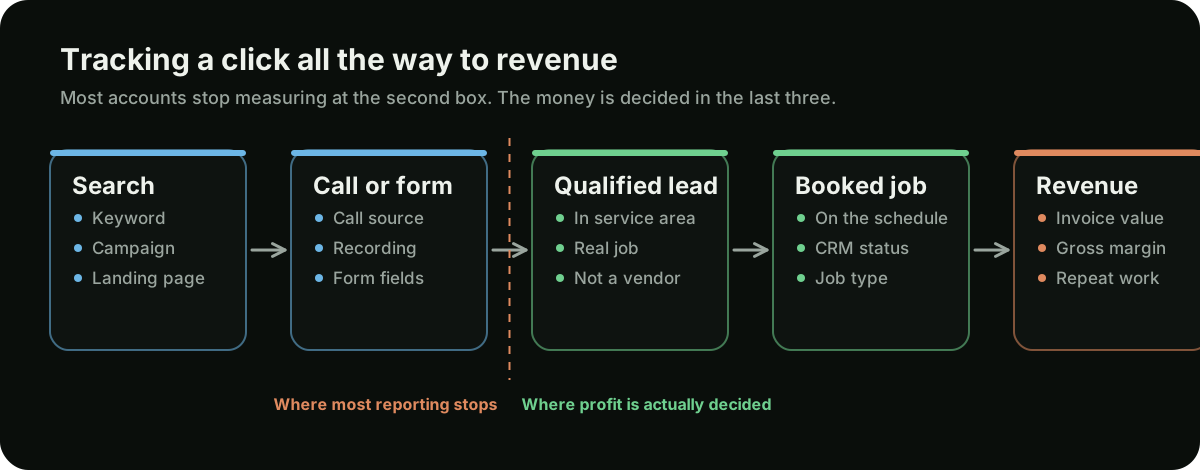
Even step one and step three together transform an account. The bidding system can only optimise toward what you tell it success looks like — and if you tell it a click is success, that is precisely what it will deliver.
Judging lead quality, not just lead volume
A campaign producing twice the leads at half the booking rate has produced nothing. Lead quality needs to be reviewed deliberately, and it takes about an hour a month.
What to look at:
- Booking rate by campaign and by keyword theme. The differences are usually stark and immediately actionable.
- Reasons leads did not book, categorised: out of area, wrong service, price shopping, unreachable, already booked elsewhere. Each category points at a different fix.
- Average ticket by source. A channel with a higher cost per lead that produces replacements is often the more valuable one.
- Call recordings from the leads that did not book. Frequently the problem is the phone handling, not the ad.
- Time to first response, especially on form submissions and after-hours calls.
Out-of-area calls point at geographic settings. Wrong-service calls point at keywords and negatives. Unreachable leads point at follow-up speed. Price shopping in volume points at the landing page not qualifying well enough. The categories are the diagnosis.
The arithmetic that decides whether it works
The following numbers are deliberately round and illustrative — substitute your own. The point is the chain, not the figures.
| Step | Calculation | Illustrative figure |
|---|---|---|
| Ad spend | What you invested in the period | $4,000 |
| Leads | Qualified calls and forms | 40 |
| Cost per lead | Spend ÷ leads | $100 |
| Booking rate | Booked appointments ÷ leads | 65% |
| Cost per booked call | Cost per lead ÷ booking rate | $154 |
| Completed jobs | Appointments that produced invoiced work | 22 |
| Cost per completed job | Spend ÷ completed jobs | $182 |
| Revenue produced | Invoiced revenue from those jobs | Your figure |
| Verdict | Compare cost per completed job to gross margin per job | Yes or no, not a feeling |
Three observations that follow from doing this properly. First, cost per lead on its own is close to meaningless — a $60 lead that books at 30% is worse than a $120 lead that books at 80%. Second, campaigns that produce replacements can carry a far higher cost per lead than repair campaigns, which is why blending them hides the truth. Third, improving your booking rate is usually cheaper than improving your cost per click, and it is entirely within your control.
We deliberately do not publish CPC, CPL, or conversion-rate benchmarks. Anything credible in that space is market-specific and dated within a season, and quoting figures we cannot source properly would be worse than useless to you.
Setting your HVAC Google Ads budget
The arithmetic above tells you whether spend is working. Setting the starting figure uses the same inputs in reverse: average ticket and gross margin by job type decide what you can afford to pay for a completed job, your booking and close rates turn that into an acceptable cost per lead, and technician capacity caps how many extra calls you can actually run. A budget that produces more calls than your crews can serve is not an investment, it is a queue.
We walk through that calculation step by step, including how to split it between emergency, repair, and replacement campaigns, in how much to spend on HVAC Google Ads. If you want to run your own numbers first, the cost per lead calculator lets you plug in your own spend, lead, and booking figures.
Budget allocation and seasonality
HVAC budgets should move through the year. A flat monthly spend guarantees you are underinvested during the weeks that generate the most demand and overinvested during the weeks that generate the least.
- Peak weeks: maximum coverage on emergency and repair intent. Click costs rise, but so does booking rate, and capacity is the real constraint. Watch impression share on your best terms rather than average cost per click.
- Shoulder seasons: shift, do not stop. Move budget to maintenance agreements, planned replacement, and indoor air quality, at lower total spend.
- Pre-season: get in early. The two or three weeks before the first real heat or cold are typically less competitive than the peak itself, and the demand is already forming.
- Use dayparting deliberately. If nobody answers after 6pm and you have no after-hours automation, spending at 9pm buys voicemail.
- Keep something running year round. Going fully dark loses campaign history and hands visibility to competitors, then costs more to restart.
- Set budget against capacity, not against a percentage. If you cannot serve the calls, more budget produces bad reviews rather than revenue.
Weather is the wildcard nobody controls. Contractors who watch the forecast and raise budgets ahead of a heat wave consistently do better than those who react to the phone ringing three days later.
Performance Max, smart bidding, and how much to automate
Google's automated campaign types can work for HVAC, but they need a foundation before they can help. Automation optimises toward whatever you have defined as success, using whatever data you have given it. Both of those are your responsibility.
- Smart bidding needs conversion volume and accurate conversion definitions. Fed click-based or unqualified conversions, it will efficiently buy more of them.
- Performance Max hides where spend went compared with a search campaign. For a contractor still learning which job types perform, that opacity is a real cost.
- Broad match plus automated bidding is the most reliable way to spend an HVAC budget on searches you would never have chosen.
- Start with search campaigns you control, build clean conversion data, then test automation against that baseline rather than instead of it.
- Keep brand traffic separate so automated campaigns are not credited with the calls from people who already knew your name.
The general principle: automate the bidding once the measurement is trustworthy. Automating on top of broken tracking multiplies the error.
Google Ads versus SEO for HVAC
Google Ads buys demand now; SEO earns demand that keeps arriving. Ads produce calls within days, can be scaled with the weather, and stop the moment you stop paying. SEO takes months, cannot be turned up on demand, and keeps producing calls without a per-click cost once it is established. Most HVAC contractors need both — paid to stabilise volume and cover seasonal swings, organic so they are not renting all of their demand permanently.
| Google Ads | SEO and Google Business Profile | |
|---|---|---|
| Speed to first calls | Days | Weeks for profile work, months for competitive organic terms |
| Cost behaviour | Per click, rising in peak season | Investment in work, no cost per visitor afterwards |
| Control | High — job types, areas, budget, hours, message | Indirect — you influence rankings, you do not set them |
| What happens when you stop | Calls stop within a day | Visibility decays slowly over months |
| Best used for | Filling capacity now, seasonal peaks, new areas, testing which job types convert | Reducing dependence on paid, capturing research-stage demand, compounding over years |
The practical sequencing for most contractors: get tracking and response speed right first, run paid to stabilise volume and learn which job types actually convert, and use that learning to prioritise which SEO pages to build. Paid search is also the fastest way to find out whether a new service area is worth investing in organically.
For how paid search fits alongside the map pack, reviews, Meta, and speed to lead, see the wider guide to HVAC marketing. If you would rather hand the account to someone, this is how we approach Google Ads management for home service companies.
Common HVAC PPC mistakes
- One campaign for every service. Averages hide everything that matters and bidding serves nobody well.
- No negative keyword list at launch. Parts, DIY, jobs, and training searches will find your budget within days.
- Broad match with automated bidding and no supervision. A reliable way to spend efficiently on the wrong searches.
- Sending all traffic to the homepage. The click was specific; the page should be too.
- Counting clicks or page views as conversions. The bidding system will deliver exactly what you asked for.
- No call tracking. In a channel where most conversions are phone calls, this makes optimisation impossible.
- Ignoring answered-call rate. Paying premium peak-season prices for calls that ring out is the most expensive mistake available.
- Radius targeting that ignores drive time. Produces calls you decline and areas you never reach.
- Flat budget across the year. Underinvested in July, overinvested in October.
- Judging replacement campaigns on repair cost per lead. Different job value, different acceptable acquisition cost.
- Changing everything at once. Without a stable baseline you cannot tell which change helped.
- Leaving unsold replacement quotes unattended. You already paid to generate that opportunity.